Buy 0l.eu ?
We are moving the project
0l.eu .
Are you interested in purchasing the domain
0l.eu ?
domain@kv-gmbh.de · 0541-91531010
Buy 0l.eu ?
How to program neural networks?
To program neural networks, you can use programming languages like Python and libraries such as TensorFlow or PyTorch. First, you need to define the architecture of the neural network by specifying the number of layers, types of activation functions, and the number of neurons in each layer. Then, you can compile the model by choosing an optimizer and a loss function. Finally, you can train the neural network using a dataset by fitting the model to the data and adjusting the weights through backpropagation. **
Can artificial neural networks have feelings?
No, artificial neural networks do not have feelings. They are computational models designed to process and analyze data, but they do not possess consciousness or emotions like humans do. Neural networks operate based on mathematical algorithms and patterns, without the ability to experience emotions or feelings. **


Similar search terms for Neural Networks
Top-Angebote
Products related to Neural Networks:
-
The Ghost Map: A Street, an Epidemic and the Hidden Power of Urban Networks. by Steven JohnsonDescription. From the bestselling author of Everything Bad is Good For You, Steven Johnson's The Ghost Map vividly recreates Victorian London to show how huge populations live together, how cities can kill - and how they can save us.. Steven Johnson is one of today's most exciting writers about popular culture, urban living and new technology. In The Ghost Map he tells the story of the terrifying cholera epidemic that engulfed London in 1854, and the two unlikely heroes - anesthetist Doctor John Snow and affable clergyman Reverend Henry Whitehead - who defeated the disease through a combination of local knowledge, scientific research and map-making.. In telling their extraordinary story, Steven Johnson also explores a whole world of ideas and connections, from urban terror to microbes, ecosystems to the Great Stink, cultural phenomena to street life.. 'A wonderful book'. Mail on Sunday. 'A thumping page-turner'. Daily Telegraph. 'Enthralling ... vivid and gripping'. New Statesman. 'Exhilarating'. Spectator. 'It is a rattling scientific mystery, but in the hands of Steven Johnson it becomes something much richer ... a vast, interconnected picture about urban and bacterial life ... it is difficult to do justice to the exuberance of Johnson's ideas'. Scotland on Sunday. Steven Johnson is the author of the acclaimed books Everything Bad is Good for You, Mind Wide Open, Where Good Ideas Come From, Emergence and Interface Culture. His writing appeared in the Guardian, the New Yorker, Nation and Harper's, as well as the op-ed pages of The New York Times and the Wall Street Journal. He is a Distinguished Writer In Residence at NYU's School Of Journalism, and a Contributing Editor to Wired.. Title. The Ghost Map: A Street, an Epidemic and the Hidden Power of Urban Networks. by Steven Johnson. Delivery. Content. Reviews9,99 £*Shipping: 2,99 £Secure redirect to the provider
-
Spelling and Vocabulary practice activities for children ages 6-7 (Year 2). Perfect for Home Learning.: (Scholastic English Skills)Master spelling and vocabulary and build English skills This workbook supports children to develop their spelling and vocabulary skills through fun and engaging activities which will help motivate your child's learning and confidence. A progress chart is also included for children to colour in as chapters are completed, and an introduction chapter on how to use the book. Content is split into: Back to basics; New spellins work: consonants; Focus on vowel sound; Super suffixes; More suffixes; Homophones and tricky words; and Spelling words with apostrophes. Help children feel prepared, capable and ready to tackle new challenges at school. Use at home or in school. Quickly builds confidence through regular, achievable activities that encourage independent learning. Designed to complement the school curriculum, meaning children work at the right level, so nothing feels too hard or too easy. Includes extra notes and tips to reinforce skills.4,99 £*Shipping: 1,99 £Secure redirect to the provider
-
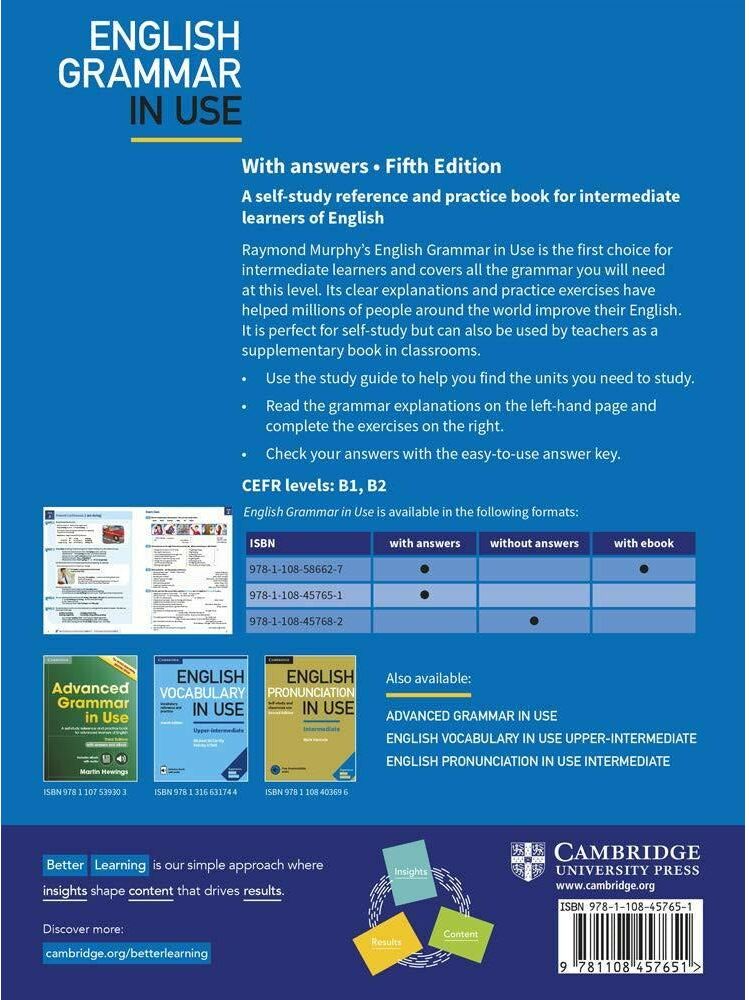
Cambridge University Press English Grammar in Use with Answers by Raymond Murphy – Self-Study Grammar Book for Intermediate LearnersEnglish Grammar in Use with Answers; authored by Raymond Murphy; is the first choice for intermediate (B1-B2) learners and covers all the grammar required at this level. It is a self-study book with simple explanations and lots of practice exercises; and has helped millions of people around the world to communicate in English. It is also trusted by teachers and can be used as a supplementary text in classrooms.12,49 £*Shipping: 2,99 £Secure redirect to the provider
-
Collins Easy Learning Grammar and Punctuation Ages 7-9: Prepare for school with easy home learningDescription. Title :. Grammar and Punctuation Ages 7-9: Prepare for school with easy home learning. Condition: BRAND NEW. Format: Paperback. ISBN: 9780008134228. Combining useful English practice with engaging, colourful illustrations, this Grammar and Punctuation practice book helps to boost your child’s confidence and develop good learning habits for life. Each fun activity is designed to give your child a real sense of achievement.Included in this book:questions that allow children to practise the important skills learned at schoolcolourful activities that make learning fun and motivate children to learn at home helpful tips and answers so that you can support your child’s learning. About the Author:. Colourful and engaging activity books really help children progress at every stage of their learning. With helpful questions and answers, this best-selling range provides reassurance whilst supporting learning at home. Combining useful practice with motivating activities, they help to boost confidence and give children a real sense of achievement.. Title. Grammar and Punctuation Ages 7-9: Prepare for school with easy home learning. Delivery. Content. Reviews3,99 £*Shipping: 2,99 £Secure redirect to the provider



-
How do you program neural networks?
To program neural networks, you can use programming languages such as Python and libraries like TensorFlow, Keras, or PyTorch. First, you define the architecture of the neural network by specifying the number of layers, the number of neurons in each layer, and the activation functions. Then, you compile the model by specifying the loss function, optimizer, and metrics. Finally, you train the neural network by providing input data and corresponding output labels, and then evaluate its performance on a separate test dataset. This process involves adjusting the model's parameters through backpropagation to minimize the loss and improve its predictive accuracy. **
-
Can artificial neural networks have emotions?
Artificial neural networks are computational models inspired by the human brain, but they do not have emotions. They are designed to process and analyze data to perform specific tasks, such as image recognition or language translation. Emotions are complex psychological states that involve subjective experiences, physiological responses, and behavioral reactions, which are not part of the functionality of artificial neural networks. While researchers are exploring ways to incorporate emotional intelligence into AI systems, current neural networks do not possess emotions. **
-
Which programming language is best suited for programming neural networks?
Python is widely considered the best programming language for programming neural networks. It has a rich ecosystem of libraries and frameworks specifically designed for machine learning and neural network development, such as TensorFlow, Keras, and PyTorch. Python's simplicity, readability, and flexibility make it an ideal choice for implementing complex neural network algorithms and models. Additionally, Python has a large and active community, providing ample resources and support for developers working on neural network projects. **
-
Are neural networks and AI the same thing?
No, neural networks and AI are not the same thing. AI, or artificial intelligence, is a broad field of computer science that focuses on creating machines that can perform tasks that typically require human intelligence. Neural networks, on the other hand, are a specific type of AI model that is inspired by the structure and function of the human brain. Neural networks are a tool used within the broader field of AI to process and analyze complex data, but they are just one component of AI as a whole. **


How are cameras used in artificial neural networks?
Cameras are used in artificial neural networks to capture visual data, such as images and videos, which are then processed and analyzed by the network. The camera input is fed into the neural network, which uses layers of interconnected nodes to extract features and patterns from the visual data. This allows the network to recognize objects, classify images, and perform tasks such as object detection and image segmentation. Cameras are an important tool for providing real-world visual input to neural networks, enabling them to learn and make decisions based on visual information. **
Should one use C or C++ for fast neural networks?
Both C and C++ can be used for fast neural networks, but C++ may be a better choice due to its object-oriented features and higher level of abstraction. C++ allows for better organization and management of complex neural network structures, and its standard library includes useful data structures and algorithms that can be leveraged for efficient neural network implementation. Additionally, C++ supports modern programming paradigms such as template metaprogramming and functional programming, which can further optimize neural network performance. Overall, while both languages can be used, C++ may offer more advantages for developing fast and efficient neural networks. **
Top-Angebote
Products related to Neural Networks:
-
Meta Ray-Ban Display Standard Shiny Black & Neural Band (Size 3), Used - Like New.gadcet-pdp{--g-green:#00a651;color:#1f2430;line-height:1.55;font-size:inherit;max-width:760px}.gadcet-pdp>*:first-child{margin-top:0}.gadcet-pdp p{margin:0 0.9em}.gadcet-pdp h3{font-size:1.05em;font-weight:600;color:#11161f;margin:1.4em 0.5em;padding-left:.5em;border-left:3px solid var(--g-green);border-radius:0;line-height:1.3}.gadcet-pdp ul{list-style:none!important;margin:0 0.9em;padding:0!important}.gadcet-pdp ul li{position:relative;padding:.1em 0.1em 1.5em;margin:0}.gadcet-pdp ul li::before{content:"";position:absolute;left:.16em;top:.45em;width:.36em;height:.66em;border:solid var(--g-green);border-width:0.14em.14em 0;transform:rotate(45deg)}.gadcet-pdp table{width:100%;border-collapse:collapse;margin:.3em 0 1em;font-size:.95em;border:1px solid #e7e9ee!important;border-radius:8px;overflow:hidden}.gadcet-pdp table td{padding:.5em.8em;border-bottom:1px solid #eef0f4!important;vertical-align:top}.gadcet-pdp table tr:last-child td{border-bottom:0!important}.gadcet-pdp table tr:nth-child(even){background:#f7f9f8}.gadcet-pdp table td:first-child{font-weight:600;color:#454c59;width:40%}@media (max-width:600px){.gadcet-pdp table td:first-child{width:42%}} Step away from the screen without losing it. The Meta Ray-Ban Display pairs iconic Ray-Ban styling in a shiny black frame with a private full-colour display in the right lens, a 12MP ultra-wide camera and open-ear audio — all controlled by the included Meta Neural Band, which reads subtle muscle signals so you can navigate with natural hand movements. Key Features Meta Ray-Ban Display smart glasses in a Standard Shiny Black frame 600 × 600 full-colour display built into the right lens for private in-lens viewing Meta Neural Band Size 3 (Large) included — advanced EMG gesture control with haptic feedback 12MP ultra-wide camera with 3× digital zoom and high-resolution video recording Meta AI voice assistant, plus supported live translation, walking navigation and smart messaging Open-ear audio with dual built-in speakers and an advanced multi-microphone system for hands-free calls Transitions Clear/Grey photochromic lenses that adapt to changing light 32GB internal storage Up to 6 hours mixed-use battery life, extendable to up to 30 hours total with the portable charging case Up to 18 hours battery life from the Neural Band Bluetooth 5.3 and Wi-Fi connectivity with Meta AI app compatibility IPX4 water resistance Benefits See notifications, messages and directions in your line of sight instead of reaching for your phone Control supported features with subtle finger and hand movements — no tapping or swiping at the frame Stay aware of your surroundings thanks to open-ear audio that leaves your ears free Capture photos and first-person video exactly as you see them One pair of glasses for indoor and outdoor use, with lenses that adapt to the light Keep everything protected and topped up on the move with the portable charging case Specifications Frame colour Standard Shiny Black Display 600 × 600...693,99 £*Shipping: 0,00 £Secure redirect to the provider
-
Collins Easy Learning Spanish Grammar And Practice: Trusted Support For Learning - Non FictionTitle:. Easy Learning Spanish Grammar and Practice Overview:. Master the essential foundations of Spanish with Easy Learning Spanish Grammar and Practice, a comprehensive non-fiction guide engineered to demystify complex grammar rules while building genuine, usable confidence through targeted exercises. This trusted resource moves well beyond passive reading, offering a structured, interactive pathway for learners to understand the mechanics of the language and immediately apply that knowledge. Ideal for individuals navigating the early stages of language acquisition or solidifying intermediate skills, the book functions as a versatile companion that adapts to varied learning styles and paces. By pairing clear, jargon-free explanations with practical application tasks, it ensures that every grammatical concept transforms into functional competence. The content covers critical areas such as verb conjugations, sentence syntax, noun agreement, and descriptive structures, presenting them in a logical sequence that reinforces memory retention. Readers benefit from a design that prioritises clarity over complexity, stripping away intimidating linguistic terminology in favour of straightforward insights that get straight to the point. As a standalone volume, it provides everything needed to tackle the challenges of Spanish grammar independently, making it a highly efficient choice for self-motivated students seeking reliable support for their studies. What Makes This Book Stand Out:. The standout feature of Easy Learning Spanish Grammar and Practice is its relentless integration of the "practice" promise directly into the learning flow. Unlike reference manuals that relegate exercises to the back, this book embeds practice questions seamlessly alongside explanations, allowing readers to test their understanding instantly and receive immediate feedback within the context of each topic. This active recall methodology significantly enhances long-term retention compared to traditional review habits. Furthermore, the book employs an effective scaffolding approach; new rules are introduced only after core principles are secure, preventing cognitive overload and ensuring a steady buildup of competence. The layout further distinguishes itself through high readability standards, featuring generous spacing, helpful navigation aids, and a presentation that respects the learner's time. The text also shines in its ability to contextualise grammar, showing how abstract rules translate into real-world communication, thereby bridging the gap between academic theory and spoken fluency. This balanced focus on both mechanical accuracy and communicative utility gives the book exceptional versatility. It serves equally well as a primary study textbook, a rapid-reference guide for assignment preparation, and a durable portfolio piece that grows more valuable with every chapter reviewed. Who This Book Is Perfect For:. Easy Learning Spanish Grammar and Practice caters to a...12,99 £*Shipping: 2,99 £Secure redirect to the provider
-
The Ghost Map: A Street, an Epidemic and the Hidden Power of Urban Networks. by Steven JohnsonDescription. From the bestselling author of Everything Bad is Good For You, Steven Johnson's The Ghost Map vividly recreates Victorian London to show how huge populations live together, how cities can kill - and how they can save us.. Steven Johnson is one of today's most exciting writers about popular culture, urban living and new technology. In The Ghost Map he tells the story of the terrifying cholera epidemic that engulfed London in 1854, and the two unlikely heroes - anesthetist Doctor John Snow and affable clergyman Reverend Henry Whitehead - who defeated the disease through a combination of local knowledge, scientific research and map-making.. In telling their extraordinary story, Steven Johnson also explores a whole world of ideas and connections, from urban terror to microbes, ecosystems to the Great Stink, cultural phenomena to street life.. 'A wonderful book'. Mail on Sunday. 'A thumping page-turner'. Daily Telegraph. 'Enthralling ... vivid and gripping'. New Statesman. 'Exhilarating'. Spectator. 'It is a rattling scientific mystery, but in the hands of Steven Johnson it becomes something much richer ... a vast, interconnected picture about urban and bacterial life ... it is difficult to do justice to the exuberance of Johnson's ideas'. Scotland on Sunday. Steven Johnson is the author of the acclaimed books Everything Bad is Good for You, Mind Wide Open, Where Good Ideas Come From, Emergence and Interface Culture. His writing appeared in the Guardian, the New Yorker, Nation and Harper's, as well as the op-ed pages of The New York Times and the Wall Street Journal. He is a Distinguished Writer In Residence at NYU's School Of Journalism, and a Contributing Editor to Wired.. Title. The Ghost Map: A Street, an Epidemic and the Hidden Power of Urban Networks. by Steven Johnson. Delivery. Content. Reviews9,99 £*Shipping: 2,99 £Secure redirect to the provider
-
Spelling and Vocabulary practice activities for children ages 6-7 (Year 2). Perfect for Home Learning.: (Scholastic English Skills)Master spelling and vocabulary and build English skills This workbook supports children to develop their spelling and vocabulary skills through fun and engaging activities which will help motivate your child's learning and confidence. A progress chart is also included for children to colour in as chapters are completed, and an introduction chapter on how to use the book. Content is split into: Back to basics; New spellins work: consonants; Focus on vowel sound; Super suffixes; More suffixes; Homophones and tricky words; and Spelling words with apostrophes. Help children feel prepared, capable and ready to tackle new challenges at school. Use at home or in school. Quickly builds confidence through regular, achievable activities that encourage independent learning. Designed to complement the school curriculum, meaning children work at the right level, so nothing feels too hard or too easy. Includes extra notes and tips to reinforce skills.4,99 £*Shipping: 1,99 £Secure redirect to the provider
-
How to program neural networks?
To program neural networks, you can use programming languages like Python and libraries such as TensorFlow or PyTorch. First, you need to define the architecture of the neural network by specifying the number of layers, types of activation functions, and the number of neurons in each layer. Then, you can compile the model by choosing an optimizer and a loss function. Finally, you can train the neural network using a dataset by fitting the model to the data and adjusting the weights through backpropagation. **
-
Can artificial neural networks have feelings?
No, artificial neural networks do not have feelings. They are computational models designed to process and analyze data, but they do not possess consciousness or emotions like humans do. Neural networks operate based on mathematical algorithms and patterns, without the ability to experience emotions or feelings. **
-
How do you program neural networks?
To program neural networks, you can use programming languages such as Python and libraries like TensorFlow, Keras, or PyTorch. First, you define the architecture of the neural network by specifying the number of layers, the number of neurons in each layer, and the activation functions. Then, you compile the model by specifying the loss function, optimizer, and metrics. Finally, you train the neural network by providing input data and corresponding output labels, and then evaluate its performance on a separate test dataset. This process involves adjusting the model's parameters through backpropagation to minimize the loss and improve its predictive accuracy. **
-
Can artificial neural networks have emotions?
Artificial neural networks are computational models inspired by the human brain, but they do not have emotions. They are designed to process and analyze data to perform specific tasks, such as image recognition or language translation. Emotions are complex psychological states that involve subjective experiences, physiological responses, and behavioral reactions, which are not part of the functionality of artificial neural networks. While researchers are exploring ways to incorporate emotional intelligence into AI systems, current neural networks do not possess emotions. **
Similar search terms for Neural Networks
-
Cambridge University Press English Grammar in Use with Answers by Raymond Murphy – Self-Study Grammar Book for Intermediate LearnersEnglish Grammar in Use with Answers; authored by Raymond Murphy; is the first choice for intermediate (B1-B2) learners and covers all the grammar required at this level. It is a self-study book with simple explanations and lots of practice exercises; and has helped millions of people around the world to communicate in English. It is also trusted by teachers and can be used as a supplementary text in classrooms.12,49 £*Shipping: 2,99 £Secure redirect to the provider
-
Collins Easy Learning Grammar and Punctuation Ages 7-9: Prepare for school with easy home learningDescription. Title :. Grammar and Punctuation Ages 7-9: Prepare for school with easy home learning. Condition: BRAND NEW. Format: Paperback. ISBN: 9780008134228. Combining useful English practice with engaging, colourful illustrations, this Grammar and Punctuation practice book helps to boost your child’s confidence and develop good learning habits for life. Each fun activity is designed to give your child a real sense of achievement.Included in this book:questions that allow children to practise the important skills learned at schoolcolourful activities that make learning fun and motivate children to learn at home helpful tips and answers so that you can support your child’s learning. About the Author:. Colourful and engaging activity books really help children progress at every stage of their learning. With helpful questions and answers, this best-selling range provides reassurance whilst supporting learning at home. Combining useful practice with motivating activities, they help to boost confidence and give children a real sense of achievement.. Title. Grammar and Punctuation Ages 7-9: Prepare for school with easy home learning. Delivery. Content. Reviews3,99 £*Shipping: 2,99 £Secure redirect to the provider
-
Collins Easy Learning English Grammar And Punctuation 1 By Collins Education - Non Fiction - PaperbackTitle:. Collins Easy Learning English Grammar And Punctuation 1 Format: Paperback Overview:. The Collins Easy Learning English Grammar And Punctuation 1 delivers a focused, highly practical introduction to the foundational rules that govern effective written English. Published by Collins Education, this volume serves as the first entry in a widely respected instructional series designed to break down complex linguistic concepts into manageable, easy-to-follow lessons. Rather than presenting dense theoretical lectures, the book adopts a structured, activity-driven approach that guides readers through essential grammar topics, punctuation conventions, clause construction, and common syntactical patterns. Each chapter pairs clear explanations with targeted exercises that reinforce understanding through immediate application. The layout prioritises readability, using spacious margins, defined headings, and visual cues that make self-directed study straightforward. Whether you are preparing for formal assessments, rebuilding foundational literacy skills after years away from academia, or simply aiming to eliminate recurring errors in everyday documents, this guide provides a reliable pathway to clearer, more confident writing. By combining curriculum-aligned content with proven pedagogy, the book bridges the gap between passive reading and active mastery, ensuring that every lesson translates directly into improved communication habits outside the page. What Makes This Book Stand Out:. Unlike traditional grammar textbooks that overwhelm readers with exhaustive terminology and rigid formatting, this volume thrives on accessibility and progressive skill building. The standout feature is its deliberate pacing: each rule is introduced through a concise explanation, immediately followed by contextual examples that mirror real-world usage. Practice tasks are embedded throughout rather than quarantined at the end, allowing readers to test comprehension in the moment and receive structured feedback loops. The editorial design intentionally avoids decorative clutter, keeping attention fixed on syntax, punctuation marks, sentence boundaries, and error correction strategies. Every chapter concludes with review checkpoints that help learners identify weak spots before advancing, creating a cumulative mastery model instead of fragmented studying. The paperback format remains deliberately compact without sacrificing depth, striking a balance between portability and comprehensive coverage. This combination of cognitive scaffolding, clear typographic hierarchy, and purposeful exercise sequencing transforms what could easily feel mechanical into an engaging, results-oriented study tool. It respects the reader’s time, acknowledges typical stumbling blocks, and replaces confusion with repeatable frameworks that stick. Who This Book Is Perfect For:. This resource is ideally suited for secondary school students navigating National Curriculum expectations, particularly...7,99 £*Shipping: 2,99 £Secure redirect to the provider
-
Learning Resources Scramboozle Educational Game for Kids - Ages 6+ - Encourages Critical Thinking and Boosts Vocabulary SkillsIntroduce your little ones to the exciting world of learning with the Learning Resources Scramboozle Educational Game for Kids. This engaging game is designed to make learning fun while enhancing essential skills such as critical thinking, vocabulary, and teamwork. With its colorful cards and playful design, Scramboozle stimulates imagination and encourages interactive play. Perfect for family game nights or friendly competitions, Scramboozle invites children to decode silly words and race against the clock. It’s a delightful game that can be enjoyed by children aged 6 and up. Whether it's a gift for a birthday or a classroom resource, Scramboozle makes learning an enjoyable experience. It encourages critical thinking and boosts vocabulary skills with its colorful and engaging design.8,99 £*Shipping: 3,95 £Secure redirect to the provider
-
Which programming language is best suited for programming neural networks?
Python is widely considered the best programming language for programming neural networks. It has a rich ecosystem of libraries and frameworks specifically designed for machine learning and neural network development, such as TensorFlow, Keras, and PyTorch. Python's simplicity, readability, and flexibility make it an ideal choice for implementing complex neural network algorithms and models. Additionally, Python has a large and active community, providing ample resources and support for developers working on neural network projects. **
-
Are neural networks and AI the same thing?
No, neural networks and AI are not the same thing. AI, or artificial intelligence, is a broad field of computer science that focuses on creating machines that can perform tasks that typically require human intelligence. Neural networks, on the other hand, are a specific type of AI model that is inspired by the structure and function of the human brain. Neural networks are a tool used within the broader field of AI to process and analyze complex data, but they are just one component of AI as a whole. **
-
How are cameras used in artificial neural networks?
Cameras are used in artificial neural networks to capture visual data, such as images and videos, which are then processed and analyzed by the network. The camera input is fed into the neural network, which uses layers of interconnected nodes to extract features and patterns from the visual data. This allows the network to recognize objects, classify images, and perform tasks such as object detection and image segmentation. Cameras are an important tool for providing real-world visual input to neural networks, enabling them to learn and make decisions based on visual information. **
-
Should one use C or C++ for fast neural networks?
Both C and C++ can be used for fast neural networks, but C++ may be a better choice due to its object-oriented features and higher level of abstraction. C++ allows for better organization and management of complex neural network structures, and its standard library includes useful data structures and algorithms that can be leveraged for efficient neural network implementation. Additionally, C++ supports modern programming paradigms such as template metaprogramming and functional programming, which can further optimize neural network performance. Overall, while both languages can be used, C++ may offer more advantages for developing fast and efficient neural networks. **
* All prices are inclusive of VAT and, if applicable, plus shipping costs. The offer information is based on the details provided by the respective shop and is updated through automated processes. Real-time updates do not occur, so deviations can occur in individual cases. ** Note: Parts of this content were created by AI.